Paramètres
 Livraison rapide
 Livraison gratuite
 Incoterms
 Types de paiement


 Produit marketplace

Transmission d'alimentation et de données sans contact pour des solutions industrielles sans usure et nécessitant peu de maintenance
Avec la contribution de Rédacteurs nord-américains de DigiKey
2025-12-22
Des connexions flexibles et hautement fiables sont essentielles dans les applications industrielles, par exemple dans les outils robotisés et les dispositifs rotatifs comme les tables d'indexage de précision. Ces systèmes sont soumis à des mouvements et des rotations importants et sont souvent exposés à la saleté et aux vibrations, ce qui peut entraîner la défaillance des bagues collectrices ou des connecteurs conventionnels.
Les concepteurs ont besoin de nouvelles options pour surmonter les limites des solutions conventionnelles dans ces applications et d'autres applications difficiles. La nouvelle option doit pouvoir prendre en charge des connexions Ethernet duplex sécurisées jusqu'à 100 Mbps et transférer jusqu'à 50 W de puissance pour les capteurs et autres composants sur 12 mm (ou 40 mm pour les données uniquement).
Des options de montage flexibles sont nécessaires pour prendre en charge un large éventail de conceptions de systèmes, et un voyant LED simple et visible est requis pour un diagnostic rapide.
Le fonctionnement en environnements industriels difficiles exige un indice de protection IP65, et la solution doit être conforme à IK06 selon EN 62262, indiquant qu'elle peut résister à des chocs mécaniques externes d'une énergie jusqu'à 1 joule. La facilité d'installation et de remplacement minimise les coûts de maintenance et les temps d'arrêt.
Cet article commence par un bref aperçu des défis liés à l'utilisation de bagues collectrices et de connecteurs conventionnels dans diverses applications industrielles. Il examine ensuite en détail les capacités des coupleurs NearFi de Phoenix Contact, et explique comment ils répondent aux besoins électriques, mécaniques et de sécurité pour la transmission d'alimentation et de données sans contact dans les applications industrielles exigeantes.
Défis liés à la fiabilité des robots
Les changements fréquents d'outils pour les robots utilisés dans les processus d'assemblage automatisés peuvent présenter des défis importants pour les connecteurs. Ces changements d'outils peuvent impliquer des centaines de cycles de connexion/déconnexion par jour.
Chaque cycle expose les contacts à des contaminants et provoque une usure due au frottement des contacts. Si les connecteurs ne sont pas parfaitement alignés, les contacts peuvent se déformer.
Il en résulte une fiabilité réduite des connecteurs et des temps d'arrêt imprévisibles pour effectuer la maintenance. Outre les connecteurs pour la fixation des outils, certains robots utilisent des bagues collectrices pour la transmission des données et de l'alimentation dans les articulations et les bras rotatifs.
Limites des bagues collectrices
Les bagues collectrices sont également utilisées dans les éoliennes, les chaînes de traitement et de conditionnement alimentaires et pharmaceutiques, ainsi que dans d'autres processus industriels. Comme les connecteurs classiques, les bagues collectrices peuvent être endommagées par l'exposition à des contaminants et peuvent subir une usure mécanique excessive.
Les bagues collectrices peuvent chauffer en raison du frottement et elles requièrent une attention particulière en matière de gestion thermique. Dans certaines applications, les bagues collectrices peuvent être soumises à de fortes vibrations ou à des chocs soudains susceptibles d'entraîner des dommages, une pression de contact instable, voire une défaillance mécanique.
Les bagues collectrices et les connecteurs conventionnels peuvent poser des défis de conception des machines, en raison des contraintes de taille et de mouvement et des exigences d'accès pour la maintenance. À cela s'ajoutent les nombreux défis liés à l'application, tels que les connexions intermittentes causées par les vibrations, la poussière, la saleté et l'usure des contacts, entre autres.
Solution NearFi
L'utilisation de « meilleurs » connecteurs peut permettre l'amélioration progressive des performances ou de la fiabilité. Mais une approche innovante qui élimine les problèmes de connexion les plus délicats est essentielle. C'est là que NearFi entre en jeu.
NearFi est une technologie sans contact qui permet la communication et le transfert d'alimentation fiables et sans usure à travers un espace d'air de quelques centimètres ou à travers des matériaux non métalliques, tels que le plastique, le verre et le bois. Pour la transmission de données uniquement, NearFi peut établir une connexion à travers un espace d'air de 40 mm. Les transmissions d'alimentation ou d'alimentation et de données combinées peuvent se faire à travers un espace d'air de 12 mm.
NearFi utilise la technologie sans fil 60 GHz pour transmettre des données et le couplage inductif pour transmettre l'alimentation d'un coupleur de base vers un coupleur à distance. Les coupleurs sont dotés d'un boîtier répertorié IP65 et IK06, ainsi que d'une technologie de connexion M12, garantissant un fonctionnement sans usure et sans maintenance dans les environnements industriels exigeants.
Avec le système NearFi, les concepteurs ont le choix entre trois solutions :
- Les données et l'alimentation peuvent être transférées simultanément à l'aide du coupleur de base 1234224 et du coupleur à distance 1234225.
- L'alimentation peut être couplée sans prise en charge des données en utilisant le coupleur de base 1234226 et le coupleur à distance 1234229.
- Les données peuvent être transmises sans transfert d'alimentation en utilisant le coupleur de base 1234232 et le coupleur à distance 1234234.
Ethernet en duplex intégral
Avec NearFi, les données sont échangées simultanément dans les deux sens sans latence. L'utilisation de deux connexions parallèles de 60 GHz sur des bandes de fréquences distinctes, l'une pour la liaison montante et l'autre pour la liaison descendante, permet des transmissions de données en temps réel en duplex intégral. Cette technologie est donc parfaitement adaptée aux protocoles industriels sensibles au temps, tels que PROFINET et EtherCAT. Comme la technologie de transmission est indépendante du protocole, elle peut être utilisée avec n'importe quel protocole Ethernet standard (Figure 1).
 Figure 1 : NearFi prend en charge l'Ethernet 100 Mbps en duplex intégral, indépendant du protocole. (Source de l'image : Phoenix Contact)
L'utilisation de la communication en champ proche (NFC) est un facteur clé des performances de NearFi. Contrairement aux communications classiques en champ lointain, qui reposent sur la propagation d'ondes électromagnétiques se déplaçant indéfiniment dans l'espace, l'énergie dans la technologie NFC ne se propage pas indéfiniment. Elle décroît rapidement avec la distance. La communication en champ proche est une technologie basse consommation qui atténue encore davantage le risque d'interférences électromagnétiques (EMI).
L'utilisation de la technologie NFC garantit également une coexistence fiable avec les technologies sans fil existantes, telles que Wi-Fi ou Bluetooth. De plus, les spectres d'interférences industrielles standard n'ont pas d'impact sur les transmissions NearFi, ce qui élimine le besoin de planification des fréquences lors du déploiement de NearFi.
La portée limitée permet d'utiliser plusieurs liaisons NearFi à proximité les unes des autres sans interférence. En résumé, la technologie NFC permet des transmissions de données haut débit fiables et sans maintenance, avec une excellente immunité aux interférences électromagnétiques. Enfin, un anneau LED sur le boîtier des coupleurs affiche le statut de connexion et facilite le dépannage, accélérant ainsi la configuration et le diagnostic.
Transmissions orientées bits
L'utilisation d'une technologie de transmission synchrone orientée bits est un autre élément clé des performances de NearFi. La technologie orientée bits contraste avec la transmission orientée paquets des autres technologies de communication sans fil.
Les implémentations orientées paquets souffrent généralement d'une latence importante. Les données arrivent au niveau de l'émetteur et doivent être organisées en paquets avant la transmission. Côté récepteur, les paquets doivent être décompressés avant de pouvoir transmettre les données au système.
Dans les transmissions synchrones NearFi, les données sont envoyées directement, bit par bit, au fur et à mesure de leur arrivée, sans création et extraction de paquets. Cela produit un flux de données continu et élimine pratiquement toute latence. C'est pourquoi NearFi est bien adapté aux protocoles Ethernet industriels sensibles au temps, tels que TSN, PROFINET et EtherCAT (Figure 2).
 Figure 2 : NearFi utilise des transmissions orientées bits pour atténuer les problèmes de latence généralement associés aux communications par paquets traditionnelles. (Source de l'image : Phoenix Contact)
En outre, comme les données sont transmises sans mise en mémoire tampon ni création de paquets, NearFi est transparent au niveau du protocole et peut prendre en charge n'importe quel protocole Ethernet sans nécessiter de configuration.
NearFi répond aux exigences de sécurité en limitant la communication à une courte distance. Il peut également prendre en charge des mesures de sécurité de haut niveau, telles que le chiffrement, l'authentification et la tokenisation.
Distribution d'alimentation
Le système NearFi utilise la transmission d'alimentation inductive avec une gamme de fréquences de 100 à 148,5 kHz, similaire à celle utilisée dans certains chargeurs sans fil pour smartphones. Il est possible de transmettre jusqu'à 50 W (24 VCC, 2 A), et jusqu'à 100 W avec une connexion parallèle.
Le contrôle actif en boucle fermée garantit une transmission de puissance constante sur toute la zone de fonctionnement. La transmission de deux tensions électriquement isolées (de 50 W chacune) est également prise en charge. Comme pour les connexions de données, un coupleur de base et un coupleur à distance sont également utilisés pour la distribution d'alimentation.
Le coupleur de base reçoit une alimentation de 24 VCC d'une source telle qu'un contrôleur. Le convertisseur de tension de capteur/alimentation de communication intégré, également appelé convertisseur US (où « U » est la désignation pour la tension en allemand), convertit l'alimentation de 24 VCC en alimentation haute fréquence pour la transmission inductive. Le coupleur à distance reçoit une alimentation inductive haute fréquence et la reconvertit en 24 VCC dans le convertisseur UA (tension d'actionneur) pour une utilisation dans les E/S, les commutateurs, les capteurs, les actionneurs et d'autres fonctions (Figure 3).
 Figure 3 : L'alimentation est couplée de manière inductive entre le coupleur de base et le coupleur à distance. (Source de l'image : Phoenix Contact)
Fonction « Fast Startup »
La fonction NearFi Fast Startup permet le rétablissement rapide (<500 ms) des liaisons en temps réel. Cela possible car la transmission d'alimentation et la communication de données commencent déjà pendant que les coupleurs NearFi se rapprochent.
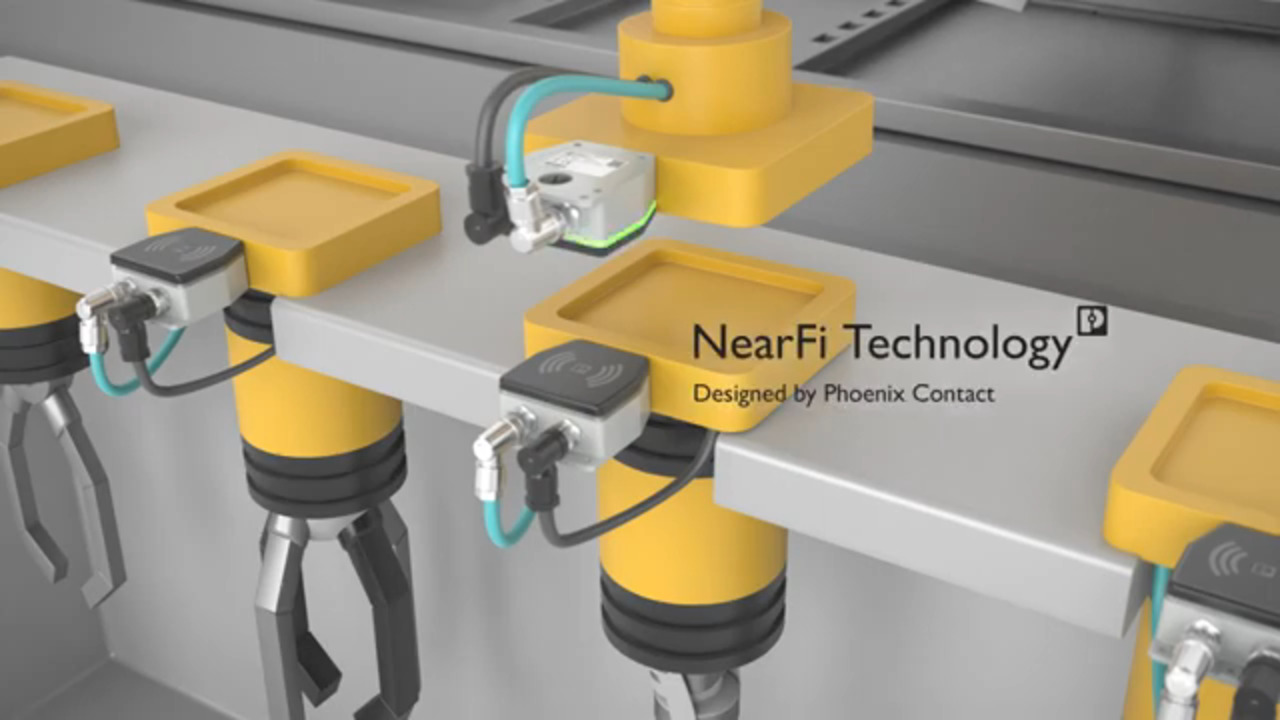
La fonction Fast Startup peut considérablement réduire les temps de cycle dans les applications telles que les changements d'outils de robots (Figure 4). La capacité de transfert de données bidirectionnel de NearFi permet également au nouvel outil (ou autre accessoire) de s'identifier auprès du système, confirmant ainsi qu'il s'agit du bon élément.
 Figure 4 : Utilisation possible de NearFi dans une station de changement d'outils de robot. (Source de l'image : Phoenix Contact)
Autres exemples d'applications
Les coupleurs NearFi peuvent être placés face à face, avec un décalage ou selon un angle tangentiel. Ils peuvent également être utilisés dans des applications où le coupleur de base est fixe tandis que le coupleur à distance tourne (Figure 5). Les coupleurs NearFi sont prêts à l'emploi, éliminant ainsi le besoin de programmation et accélérant le développement et le déploiement des applications.
 Figure 5 : Dans cette application, le coupleur à distance à gauche est en rotation tandis que le coupleur de base à droite est fixe. (Source de l'image : Phoenix Contact)
Les mêmes caractéristiques qui rendent NearFi adapté à une utilisation dans les changements d'outils de robots peuvent également répondre aux besoins d'applications telles que les véhicules à guidage automatique (AGV) et les convoyeurs de matériaux et de pièces.
Les antennes rotatives, telles que celles que l'on trouve dans les aéroports, peuvent bénéficier du remplacement des bagues collectrices conventionnelles par des coupleurs NearFi. De même, les tables d'indexage de précision sont utilisées dans les applications industrielles, ainsi que dans les remplisseuses de bouteilles dans les secteurs alimentaires et pharmaceutiques.
Conclusion
La technologie NearFi permet de résoudre une multitude de problèmes apparemment insolubles. Elle fournit sans fil un Ethernet 100 Mbps indépendant du protocole, ainsi qu'une puissance de 50 W, tout en étant flexible et facile à utiliser. Les coupleurs NearFi sont conçus pour une utilisation en environnements industriels difficiles, avec des indices de protection IP65 et IK06, et une connectivité M12. Comment allez-vous utiliser NearFi pour différencier votre prochaine conception ?
Lectures recommandées :
- Les nouveaux PLC contribuent à accélérer le déploiement de processus d'automatisation complexes et critiques
- Déployer la maintenance prédictive pour tirer le meilleur parti des installations de l'Industrie 4.0
- Considérations relatives aux performances de mouvement lors de la sélection de câbles VFD pour la robotique
- Optimiser les architectures de communication de l'Industrie 4.0 avec des concentrateurs et des convertisseurs E/S multiprotocoles
- Relever les défis liés au développement d'interfaces utilisateur stimulantes pour le métavers

Avertissement : les opinions, convictions et points de vue exprimés par les divers auteurs et/ou participants au forum sur ce site Web ne reflètent pas nécessairement ceux de DigiKey ni les politiques officielles de la société.