Paramètres
 Livraison rapide
Les commandes sont généralement livrées en Suisse sous 48 heures, selon le lieu de livraison.
 Livraison gratuite
Livraison gratuite vers la Suisse pour les commandes de 54 CHF ou plus. Des frais de livraison de 20 CHF seront facturés pour toute commande inférieure à 54 CHF.
 Incoterms
UPS, FedEx ou DHL, frais de transport prépayés : DDP (droits et douanes payés par DigiKey)
 Types de paiement
Compte de crédit pour les institutions et les entreprises qualifiées
Paiement à l'avance par virement bancaire


 Produit marketplace
Plus de produits de partenaires agréés
Délai moyen de livraison de 1-3 jours, des frais d'expédition supplémentaires peuvent s'appliquer. Veuillez consulter la page produit, le panier ou la commande pour plus d'informations sur le statut d'expédition.
Incoterms : CPT (droits, douanes et TVA/taxes applicables exigibles à la livraison)
Pour plus d'informations, consultez la page Aide et support
The UCC28063 is a dual-phase, transition-mode Power Factor Correction (PFC) pre-regulator. The UCC28063EVM-723 is an evaluation module (EVM) with a 390-V, 300-W, dc output that operates from a universal input of 85 VRMS to 265 VRMS and provides power-factor correction.
The Energy Monitoring PICtail™ Plus Daughter Board is a power monitor circuit that uses the highly integrated PIC18F87J72 single chip energy meter IC. This low-cost design does not use any transformers and requires few external components. It includes both an isolated USB connection for meter calibration and access to the device power calculation, and an isolated PICtail Plus connection for Explo…
The EPC9051 is a high efficiency, differential mode class-E amplifier demonstration board that can operate up to 15 MHz. This board may also be used for applications where a low side switch is utilized. Examples include, and are not limited to, push-pull converters, current-mode Class D amplifiers, common source bi-directional switch, and generic high voltage narrow pulse width applications such as LiDAR.
The MCP73833 Li-Ion Battery Charger Evaluation Board is an evaluation and demonstration tool for Microchip’s MCP73833/4 Stand-Alone Linear Li-Ion/Li-Polymer Charge Management Controllers. The evaluation board has two circuits provided with one circuit fully assembled and tested.
The TPS20xxCDRCEVM-016 and TPS20xxCDGNEVM-015 are evaluation modules (EVM) for the Texas Instruments family of dual-channel, current-limited, power distribution switches.
The Texas Instruments TPS2543EVM-064 evaluation module (EVM) helps designers evaluate the performance of the TPS2543 USB Charging Port Power Switch and Controller. The EVM contains input and output connectors. Jumper controls are also provided to ease evaluation of device features.
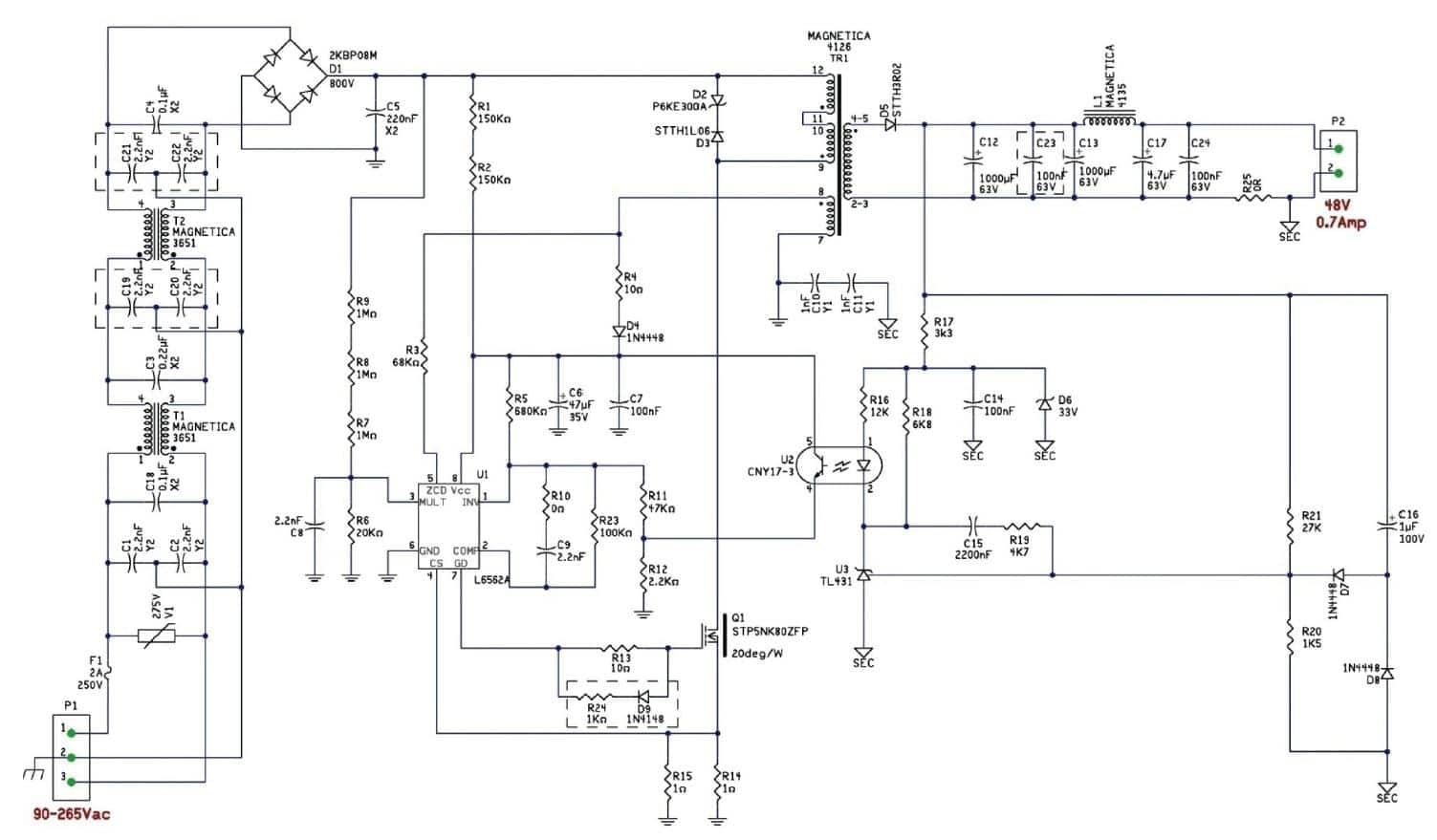
The board is a 35 W, wide-range mains input, power factor corrected SMPS (switched mode power supply) suitable for all low power applications requiring a high PF (power factor), such as lighting applications and power supplies for LEDs. The low-cost L6562A and the simple flyback topology combine to provide a very competitive PFC controller solution.
The L4981 integrated circuit is a continous mode average current controller with several specific functions for active power factor correction. It can operate in high quality, medium/high power conversion range and provides all the necessary features to achieve a very high power factor, up to 0.99. Thanks to the BCD technology used, operative switching frequency higher than 200kHz can be used.
Demonstration circuit 1621A features the LTM®8062, a 32V, 2A μModule® power tracking battery charger. The demonstration circuit is designed to operate from a 9.75V to 32V input source, and to charge a 2-cell battery pack to a float voltage of 7.2V.
Demonstration circuits 1645A-A, 1645A-B, 1645A-C and 1645A-D feature the LTM8061, a 32V, 2A μModule® Li-Ion battery charger. Operating from a 6.5V to 32V input source, the 1645A-A and 1645A-B demo circuits charge single cell Li-Ion batteries to float voltages of 4.1V or 4.2V respectively.
Co-Browse
En utilisant la fonction Co-Browse, vous acceptez de permettre à un représentant du support de DigiKey de visualiser votre navigateur à distance. Lorsque la fenêtre Co-Browse s'ouvre, donnez au représentant l'ID de session qui se trouve dans la barre d'outils.
DigiKey respecte votre droit à la vie privée. Pour plus d'informations, veuillez consulter notre Avis de confidentialité et notre Avis relatif aux cookies.
Oui, continuer avec Co-Browse
Merci.
Gardez un œil sur votre boîte de réception pour être informé des dernières nouvelles et mises à jour de DigiKey !
Veuillez entrer une adresse e-mail
Veuillez cocher la case