Einstellungen
 Schnelle Lieferung
 Kostenlose Lieferung
 Incoterms
 Zahlungsmethoden


 Marketplace-Produkt

How to Accelerate Edge AI Deployments with an NPU-Enabled Multiprotocol Wireless SoC
2026-06-17
The emergence of artificial intelligence at the network edge (edge AI) has created a need for on-device inference in wirelessly enabled Internet of Things (IoT) applications, including smart homes, building and factory automation, asset tracking, and wearables. While potentially powerful, edge AI requires ultra-low-power, flexible onboard processing and wireless connectivity, and careful attention to security and memory resources.
For many teams, gathering and implementing all the elements of an effective design, then deploying and supporting it in the field, can be challenging.
This article briefly outlines the benefits and challenges of edge AI for embedded system designers. It then introduces a wireless SoC and its associated development kit, software, and AI assistant from Nordic Semiconductor, showing how they simplify edge AI development, deployment, and management.
What is edge AI, and why is it needed?
Edge AI refers to inference or machine learning (ML) performed outside the datacenter, on devices ranging from gateways, laptops, and mobile phones to wearables and smart sensors (Figure 1). Well-designed edge AI devices can efficiently analyze data locally and respond appropriately, connecting to the cloud or a local server only when meaningful data needs to be communicated or when firmware or AI model updates are required. For many battery-powered wireless designs, where transmissions can be a relatively significant power drain, reduced wake time and fewer transmissions conserve power, potentially enabling months or years of operation on a single charge (depending on the workload and duty cycle).
Edge AI also reduces latency for fast decision-making, supports privacy and security by keeping data local on the device or sensor node, frees up wireless network bandwidth, and enables operation during a network outage.
 Figure 1: Edge AI is inference or ML performed outside the data center, on devices ranging from gateways and laptops to mobile phones, wearables, and industrial sensors. (Image source: Nordic Semiconductor)
Implementing edge AI, particularly on resource-constrained devices such as wearables and industrial sensors, requires a focus on ultra-low-power, flexible onboard processing and wireless connectivity to support evolving AI workloads and connectivity across heterogeneous networks. Developers also need to emphasize security to prevent hacking and ensure that memory is appropriately sized to support increasingly complex wireless protocols, AI models, and data types.
Given cost and time-to-market pressures in a rapidly evolving field, the hardware choices for a design must be tightly coupled with a vendor’s tools and edge AI support to enable ease of development and ensure long-term success once deployed.
A comprehensive platform built for Edge AI
To accelerate the development of edge AI solutions for embedded systems, Nordic Semiconductor added the nRF54LM20B (Figure 2) to its nRF54L series of ultra-low-power wireless systems on chip (SoCs). The nRF54LM20B combines an efficient microcontroller unit (MCU) based on a 128 MHz Arm Cortex-M33 with ultra-low-power wireless connectivity over Bluetooth LE, Matter, Thread, Zigbee, or 2.4 gigahertz (GHz) proprietary protocols, with data rates up to 4 megabits per second (Mbits/s). A 128 MHz RISC-V coprocessor is also included, along with a comprehensive set of peripherals.
 Figure 2: The nRF54LM20B SoC features flexible processing and wireless connectivity optimized for low power. (Image source: Nordic Semiconductor)
Distinguishing the nRF54LM20B from others in the nRF54L series is a relatively large amount of memory (2 megabytes (Mbytes) of nonvolatile memory (NVM) and 512 kilobytes (Kbytes) of random access memory (RAM)) and the inclusion of Nordic’s proprietary Axon neural processing unit (NPU) (Figure 3) running at 120 MHz.
 Figure 3: The nRF54LM20B’s Axon NPU efficiently accelerates execution of neural network operators with minimal CPU intervention. (Image source: Nordic Semiconductor)
Typically, adding AI acceleration to embedded or wireless IoT devices means selecting and integrating a discrete NPU, which adds cost, complexity, and inference inefficiencies. These inefficiencies scale with more demanding AI workloads, such as audio, imaging, and high-rate sensor data.
The Axon NPU addresses these issues and targets bounded, highly constrained use cases where memory, power, and space are at a premium. Designed for fast, power-efficient execution of neural network operators with minimal CPU intervention, the NPU features flexible direct memory access (DMA), an execution pipeline that supports functions beyond traditional neural network operators, and full compatibility with Nordic’s tool chain.
For example, the Axon NPU improves the speed and efficiency of TensorFlow Lite (TFL) models.
Nordic believes it is 15x faster than running the same models on the CPU and estimates that Axon is 8x more efficient and performs 7x faster inference than competing products. This efficiency and performance make it suitable for use cases including anomaly detection, biometrics, and sound, keyword, and image recognition.
Tackling memory and security
While the nRF54LM20B’s large memory facilitates processing of larger AI workloads, Nordic has also tackled the memory problem from another angle. Its custom Neuton ultra-tiny edge AI models, with a footprint of 5 Kbytes, are built from the developer’s own data using Nordic’s patented network-growing algorithm. These models then run on any Nordic SoC or system in package (SiP). Based on Nordic’s numbers, the models have a memory footprint 10x smaller than TFL models and are 10x faster and more energy-efficient than running TFL models on the CPU.
To ensure that data processed locally on an edge AI device is secure and that the device can comply with multiple regulatory requirements, the nRF54LM20B features secure boot, secure firmware update and storage, a TrustZone execution environment, a cryptographic accelerator, side-channel leakage detection, and tamper detectors.
Kit simplifies edge AI development
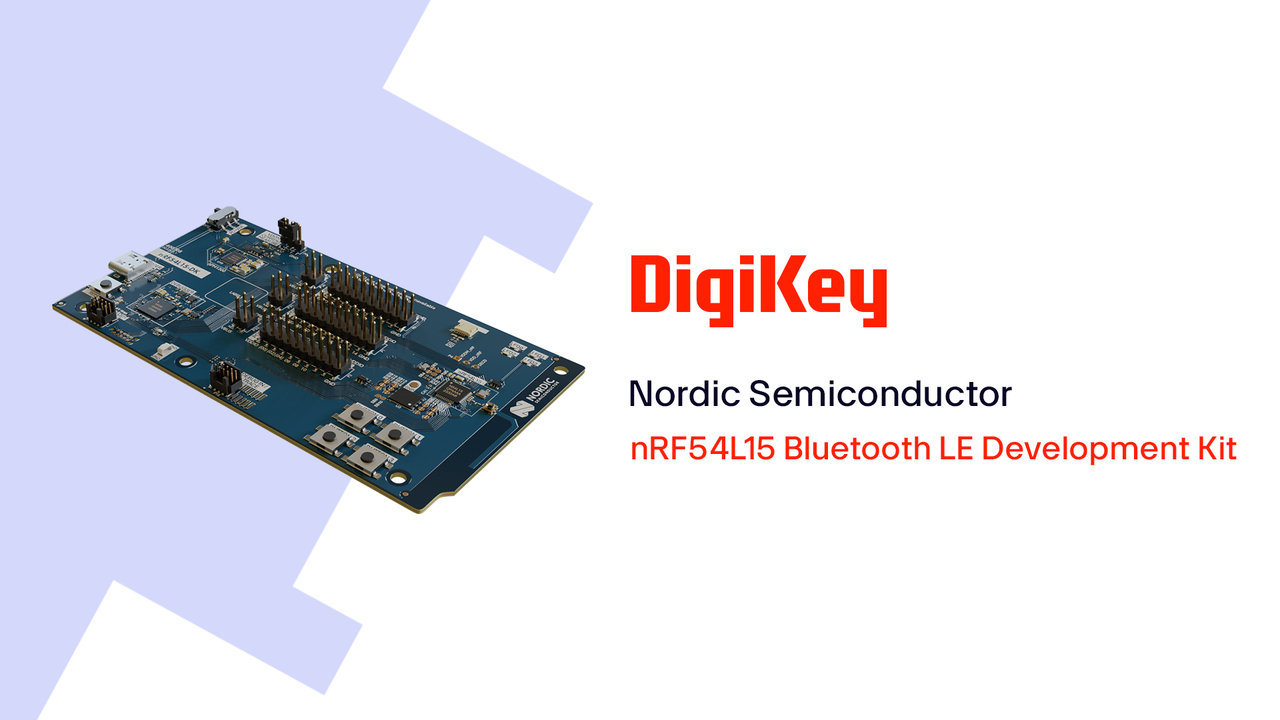
To get started with an edge AI design, developers can use the nRF54LM20-DK (Figure 4). Based on the nRF54LM20B SoC in a CSP98 package (such as the nRF54LM20B-PAAA-R), the kit includes 2.4 GHz and NFC antennas, preprogrammed firmware, documentation, hardware schematics, and layout files. Full software development support is available through the nRF Connect SDK, a unified and flexible software kit for wireless IoT product development. The kit is based on the open-source Zephyr project and also features proprietary Nordic software. “Out of the box,” it provides samples, wireless stacks, networking protocols, drivers, and security.
 Figure 4: The nRF54LM20-DK kit is based on an nRF54LM20B SoC in a CSP98 package and comes with 2.4 GHz and NFC antennas, firmware, documentation, schematics, layout files, and online resources. (Image source: Nordic Semiconductor)
Upon development, the next steps are deployment, monitoring, updating, and observability. Managing all this can become challenging over time as features are added and the number of network nodes grows. To help with this, Nordic provides nRF Cloud. This cloud-based tool securely updates and manages devices, monitors health and debug issues, and performs power-efficient global location tracking.
AI assistant for prototyping through fleet management
The nRF54LM20B-DK is supported by an AI assistant (Figure 5), allowing developers to spend less time on repetitive tasks and more time on differentiated features. For example, the assistant can create a prototype, run tests, generate documentation, and perform debug, all while the developer remains in charge, overseeing the output.
 Figure 5: An AI assistant enables developers to spend less time on repetitive tasks and more time on differentiated features. (Image source: Nordic Semiconductor)
While developers are familiar with using large language models (LLMs) in their workflow, these models are trained on generic data. While this may work for many use cases, Nordic’s AI assistant uses an implementation of the Model Context Protocol (MCP) to provide verified contextual data from the SDK, including documentation, API references, device configurations, and field data from nRF Cloud. This improves accuracy and makes more efficient use of tokens.
The AI assistant integrates with the user’s preferred models, including Claude Code, Cursor, GitHub, and Copilot, and covers the full lifecycle, from prototyping to managing deployed products.
Conclusion
Edge AI on battery-powered wireless IoT devices offers many benefits, but is complex to implement and manage effectively in resource-constrained environments. Nordic Semiconductor’s nRF54LM20B NPU-enabled multiprotocol wireless SoC and its associated kit, software, and AI assistant bring key elements together to simplify and accelerate prototyping, development, deployment, and management.
Haftungsausschluss: Die Meinungen, Überzeugungen und Standpunkte der verschiedenen Autoren und/oder Forumsteilnehmer dieser Website spiegeln nicht notwendigerweise die Meinungen, Überzeugungen und Standpunkte der DigiKey oder offiziellen Politik der DigiKey wider.